

In the intricate world of automotive engineering, the crankshaft stands as a fundamental component, especially in Nissan engines. As a dedicated supplier of crankshafts for Nissan vehicles, I've witnessed firsthand the pivotal role the crankshaft plays in engine performance, particularly in relation to valve timing. This blog post aims to delve into how the crankshaft affects valve timing in a Nissan engine, exploring the underlying mechanisms, the impact on engine operation, and the significance of high - quality crankshafts.
The Basics of Crankshaft and Valve Timing
Before we discuss the relationship between the crankshaft and valve timing, it's essential to understand what each component does. The crankshaft is a mechanical marvel that converts the linear motion of the pistons into rotational motion. It is connected to the pistons via connecting rods and is driven by the up - and - down movement of the pistons as they burn fuel and air mixture in the combustion chambers.
Valve timing, on the other hand, refers to the precise timing of the opening and closing of the intake and exhaust valves in an engine. The intake valves allow the fuel - air mixture to enter the combustion chamber, while the exhaust valves let the burned gases exit. Correct valve timing is crucial for efficient engine operation, as it ensures that the right amount of air - fuel mixture is taken in and the exhaust gases are expelled at the appropriate times.

How the Crankshaft Dictates Valve Timing
In a Nissan engine, the crankshaft is directly linked to the camshaft through a timing belt, chain, or gears. The camshaft is responsible for actuating the intake and exhaust valves. As the crankshaft rotates, it drives the camshaft at a specific ratio, typically 1:2 in a four - stroke engine. This means that for every two revolutions of the crankshaft, the camshaft makes one revolution.
The shape and position of the lobes on the camshaft determine when the valves open and close. Since the camshaft is driven by the crankshaft, any change in the rotation of the crankshaft will directly affect the movement of the camshaft and, consequently, the valve timing. For example, if the crankshaft rotates at a higher speed, the camshaft will also rotate faster, causing the valves to open and close more frequently.
Impact on Engine Performance
Proper valve timing, regulated by the crankshaft, has a profound impact on engine performance. When the valve timing is optimized, the engine can achieve better fuel efficiency, increased power output, and reduced emissions.
- Fuel Efficiency: With correct valve timing, the engine can intake the optimal amount of air - fuel mixture. If the intake valves open too early or too late, the combustion process may not be as efficient, leading to wasted fuel. For instance, if the intake valve closes too early, not enough air - fuel mixture will enter the combustion chamber, resulting in incomplete combustion.
- Power Output: The power of an engine is directly related to the amount of air - fuel mixture burned in the combustion chamber. By ensuring that the intake and exhaust valves open and close at the right times, the engine can maximize the amount of air - fuel mixture it can burn, thus increasing power output. For example, in high - performance Nissan engines, precise valve timing allows for more aggressive camshaft profiles, which can open the valves wider and for longer periods, enabling more air - fuel mixture to enter the combustion chamber.
- Emissions: Incorrect valve timing can lead to increased emissions. If the exhaust valves do not open at the right time, unburned fuel may be expelled into the exhaust system, contributing to higher levels of hydrocarbons in the emissions. By maintaining proper valve timing, Nissan engines can meet strict environmental regulations.
Our High - Quality Crankshafts for Nissan Engines
As a supplier of crankshafts for Nissan, we understand the critical role that the crankshaft plays in valve timing and overall engine performance. That's why we offer a wide range of high - quality crankshafts designed specifically for Nissan engines.
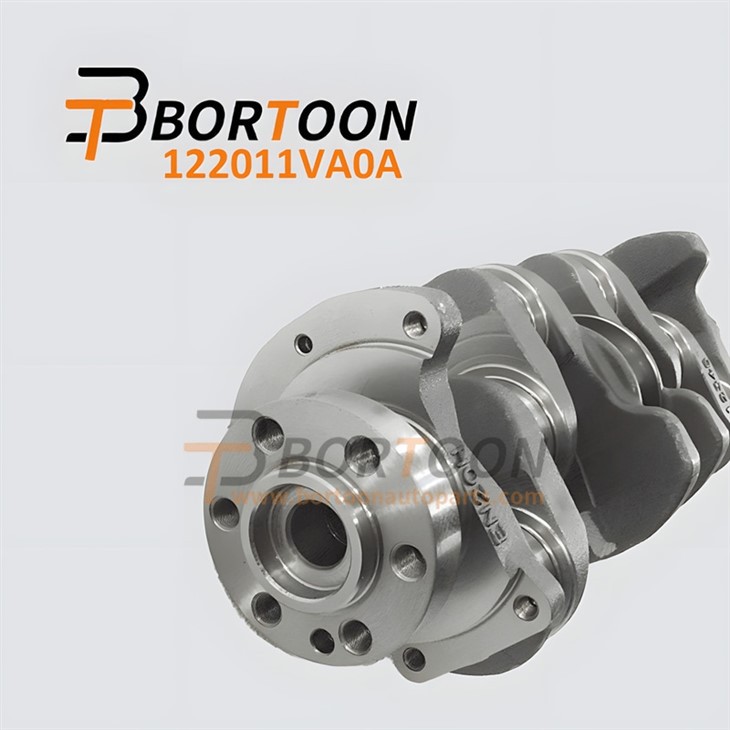
- MR20 Crankshaft for Nissan 2.0 122011VA0A: This crankshaft is engineered to provide precise control over valve timing in Nissan's 2.0 - liter MR20 engines. It is made from high - strength materials and undergoes rigorous quality control processes to ensure durability and optimal performance.
- HR16 Crankshaft for Nissan Lannia Sylphy Lannia Livna 1.6 122011KA0B - C141: Designed for Nissan's 1.6 - liter HR16 engines, this crankshaft offers excellent reliability and performance. It is precisely machined to ensure smooth rotation and accurate valve timing, which is essential for the efficient operation of these engines.
- HR15 Crankshaft for Nissan Sunny 1.5 122011KT0B - C141: Our HR15 crankshaft is tailored to meet the specific requirements of Nissan's 1.5 - liter Sunny engines. It provides stable rotation and helps maintain proper valve timing, resulting in improved fuel efficiency and power output.
Importance of Quality Crankshafts for Valve Timing
Using a high - quality crankshaft is crucial for maintaining accurate valve timing. A substandard crankshaft may have irregularities in its shape or material, which can cause uneven rotation. This uneven rotation can lead to inconsistent valve timing, resulting in poor engine performance, increased wear and tear on engine components, and potential engine damage.
Our crankshafts are manufactured using advanced technology and high - grade materials. We employ precision machining processes to ensure that each crankshaft meets the strictest specifications. This attention to detail guarantees that our crankshafts provide smooth and consistent rotation, which is essential for maintaining proper valve timing in Nissan engines.
Conclusion
In conclusion, the crankshaft is a key component in a Nissan engine that significantly affects valve timing. By converting the linear motion of the pistons into rotational motion and driving the camshaft, the crankshaft determines when the intake and exhaust valves open and close. Proper valve timing, regulated by the crankshaft, is essential for achieving optimal engine performance, including fuel efficiency, power output, and emissions control.
As a supplier of crankshafts for Nissan, we are committed to providing high - quality products that ensure accurate valve timing and reliable engine operation. If you are in the market for a crankshaft for your Nissan engine, we invite you to explore our product range. Contact us today to discuss your specific requirements and start a procurement negotiation. We look forward to serving you and helping you enhance the performance of your Nissan engine.
References
- Heywood, J. B. (1988). Internal Combustion Engine Fundamentals. McGraw - Hill.
- Crolla, D. A. (2001). Automotive Mechanics. Newnes.
- Taylor, C. F. (1966). The Internal - Combustion Engine in Theory and Practice. MIT Press.